The Korean Switch-on Diet: Implementation
14 days in and feeling......

As week two of the Korean Switch-on Diet (“KSD”) comes to a close I am feeling good! This week, however, is not about feelings. This post is all about implementation: exactly what does this diet entail?
1. The Version I’m Following
As detailed in last week’s post, it is difficult to find a single source of truth regarding the KSD. Based on my research, I’ll be following the diet element of the plan as such:
Week One
Days 1-3: Protein shakes, four times per day.
Days 4-7: Protein shakes, three times per day. High protein, low carb lunch.
Week Two
One 24 hour fast (from 8pm on day 7 to 8pm on day 8)
Days 9-14: Protein shakes, twice per day. High protein, low carb lunch. High protein, no carb dinner.
Weeks Three & Four
2-3 fasting days (24 hour)
Other days: Protein shakes, twice per day. High protein, low carb lunch. High protein, no carb dinner.
The diet also allows for tofu, Greek yoghurt and cucumber to be eaten if hungry.
2. My interpretation where necessary
In addition to the subjectivity around what constitutes a high-protein or low-carb meal discussed last week, the direction to consume ‘protein shakes’ is also vague - given the breadth of shakes available. In terms of addressing this ambiguity, I decided to consider the calorie and protein content of various options.
In terms of weight-loss, a calorie deficit is, scientifically, the only way one can lose weight. That is, burning more calories than you consume.
To estimate how many calories one should consume in order to be ‘in’ a calorie deficit, you first need to understand your total daily energy expenditure (“TDEE”). A crude assessment of this is 2000 and 2500 calories for men and women, respectively, which you will likely have noticed on food packaging/labels. However, for a more accurate assessment of TDEE, an online calculator will give you a result based on your gender, age, weight, height and activity level.
Coincidentally, as a 29 year old female, who is 170cm tall, weighs 75kg (as of 31 December 2025), doing light exercise*: my TDEE is essentially 2,000 (2,071).
*Given the KSD is quite restrictive and includes long fasting windows on occasion, I do not want to commit to exercising too frequently.
Therefore, in order to lose weight, I would need to consume c. 500-600 calories less than my TDEE. On this basis, I selected a combination of shakes and meals to a rough total of 1400-1500 calories per day.
3. The Meal Plan
As described in Section 1, the diet calls for several variations of daily meal plans including protein shakes, high protein/low carb meals and high protein/no carb meals.
I chose the following shakes to ensure I met my (loose) calorie target:
Huel Black Edition - 40g protein, 400 calories. I bought a mixed box of flavours so I hopefully don’t get bored. This is a more substantial shake for the days where that’s all I’ll drink. I had two bottled versions of this while I waited for my selection box to arrive - which had slightly different macros.
Huel Complete Protein - 20g protein, c. 100 calories. A lighter shake for when I start to add meals into the mix.
My Protein Impact Whey (Diet) - c. 30g protein, c. 200 calories. I bought a tub of this on New Year’s Eve to make sure I had some protein for day one.
Let me know if you’re interested in what low/no-carb meals I’ve eaten (and enjoyed) over the past few weeks and I will consider collating all of that (with a bit more detail than that included in the food diary at the end of this post).
4. Activity Requirements
There is further ambiguity regarding the amount of exercise required on the KSD. Some articles suggest 4 high intensity work-outs per week, whereas some suggest one hour of walking. I decided that an 8,000-10,000 daily step goal would be the easiest to track and is mostly achievable, given the diet requirements.
I’ve managed to attend various exercise classes so far, including pilates, hyrox and tap. My step count thus far is detailed in the food diary table at the end of this post.
5. Costs so far
Shakes
Total spent on shakes - £112.65
Huel Black Edition - £44.50
Huel Complete Protein (two bags) - £25 each (£50)
This is enough protein for the full four weeks, I also got a 10% discount on my first order. If you’re interested in trying Huel, you can use this link for £15 off your first order.
As mentioned in section 3, I purchased some protein to ensure I was stocked while I waited for my Huel delivery. Note that with more organisation, this wouldn’t be required.
My Protein Impact Whey (Diet) - £16
Huel Black Edition (‘grab and go’ bottles) - £11.60
Food
My total food bill thus far, that is, up to and including day 14 (excluding shakes) is £147.23. Full information is available in the food diary table at the end of this post.
Assuming I spend roughly the same on food for the remainder of the diet as I did in week #2 (when eating 2 meals per day) the total I will spend on food during this diet over four weeks is £349.23.
That is a total spend of £461.88 (or £115.47 per week or £16.50 per day).
Note that there are certain things that I bought/did that took my food bill over and above what is necessary (e.g. meals out, impulse buys (e.g. sashimi)). I also generally fed both me and my boyfriend, so I am sure this could be done for a fraction of the what I have spent.
That’s all for now! Please like and subscribe if you’re enjoying this journey. Next week, we’re looking at my experience so far on the KSD, the more qualitative side of the story…side effects, psychological impact, social hindrances etc.
Full food diary
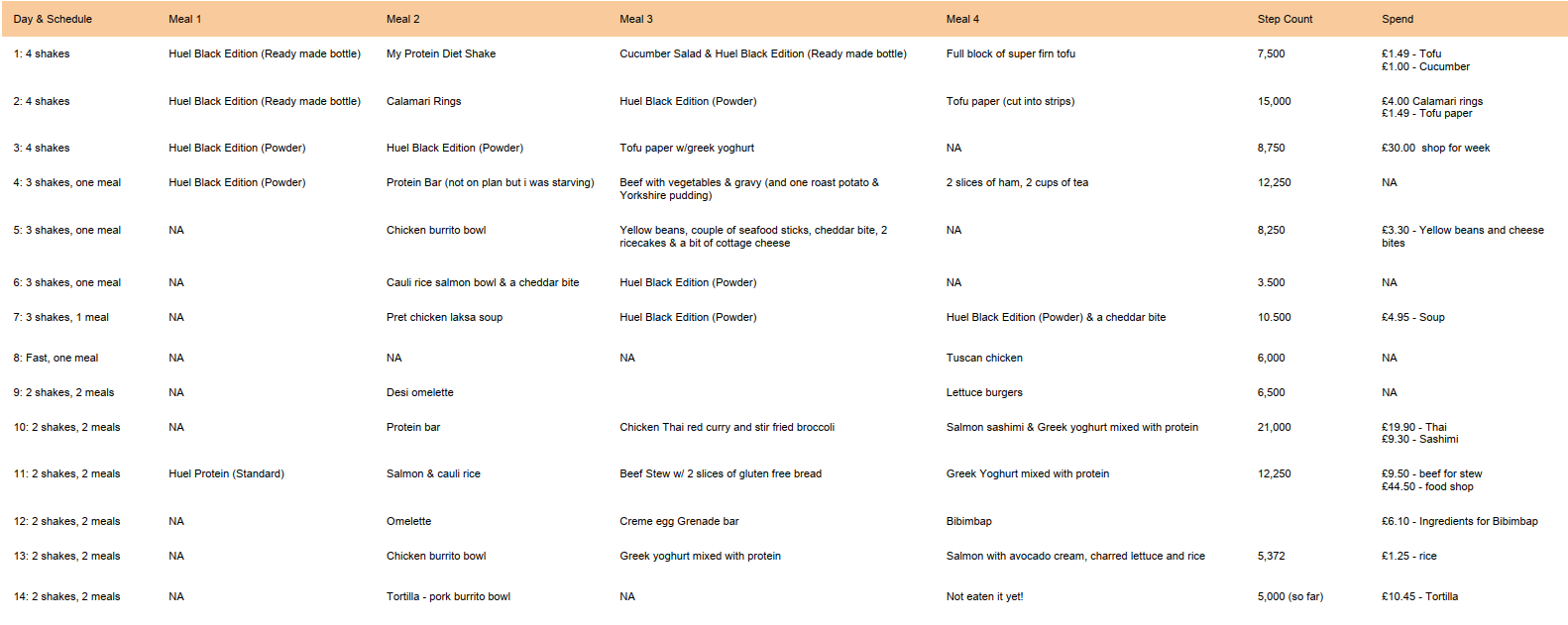
Please let me know if the full food diary is interesting/useful - and I will continue for the remainder of the diet.
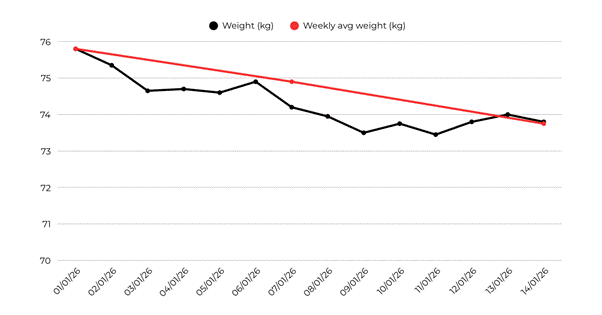
Progress so far
I enjoy the food diary, it gives a good idea of how realistic sticking to the diet fully is, and how much interpretation of the rules you did. It would be interesting to have a reflection on how difficult you found it to stick to - especially with socialising and meals out. Also, I would not have expected this diet to be so expensive!